What ‘Indoor Air Quality Testing’ Actually Means
The term “indoor air quality” (IAQ) covers everything you can’t see in the air your family or employees are breathing — carbon dioxide buildup, volatile organic compounds (VOCs) off-gassing from materials, carbon monoxide from combustion appliances, fine particulate matter (PM2.5 and PM10), humidity extremes, and biological contaminants like dust mites and mold spores.
Most homes and offices have IAQ issues at some point. Few people ever test. Air Test Pros provides a complete IAQ assessment that tells you what’s elevated, what isn’t, and what to do about it.
When You Should Test Your Indoor Air
- Persistent symptoms — headaches, fatigue, dry eyes, sore throat, or worsening asthma/allergies that improve when you leave the property
- New construction or renovation — fresh materials off-gas formaldehyde and other VOCs for weeks to months
- New baby, elderly resident, or anyone with respiratory issues — vulnerable family members benefit most from clean air
- Office complaints — multiple employees reporting stuffiness, drowsiness, or headaches typically traces to elevated CO2 from inadequate ventilation
- Combustion appliance concerns — gas furnaces, wood stoves, fireplaces, and garage-attached spaces can introduce CO into living spaces
- Real-estate transactions — buyers wanting baseline air quality documentation alongside mold and radon testing
- Recent water damage — even after the visible cleanup, hidden moisture often shows up in IAQ readings before mold becomes obvious
What We Measure
Carbon Dioxide (CO2)
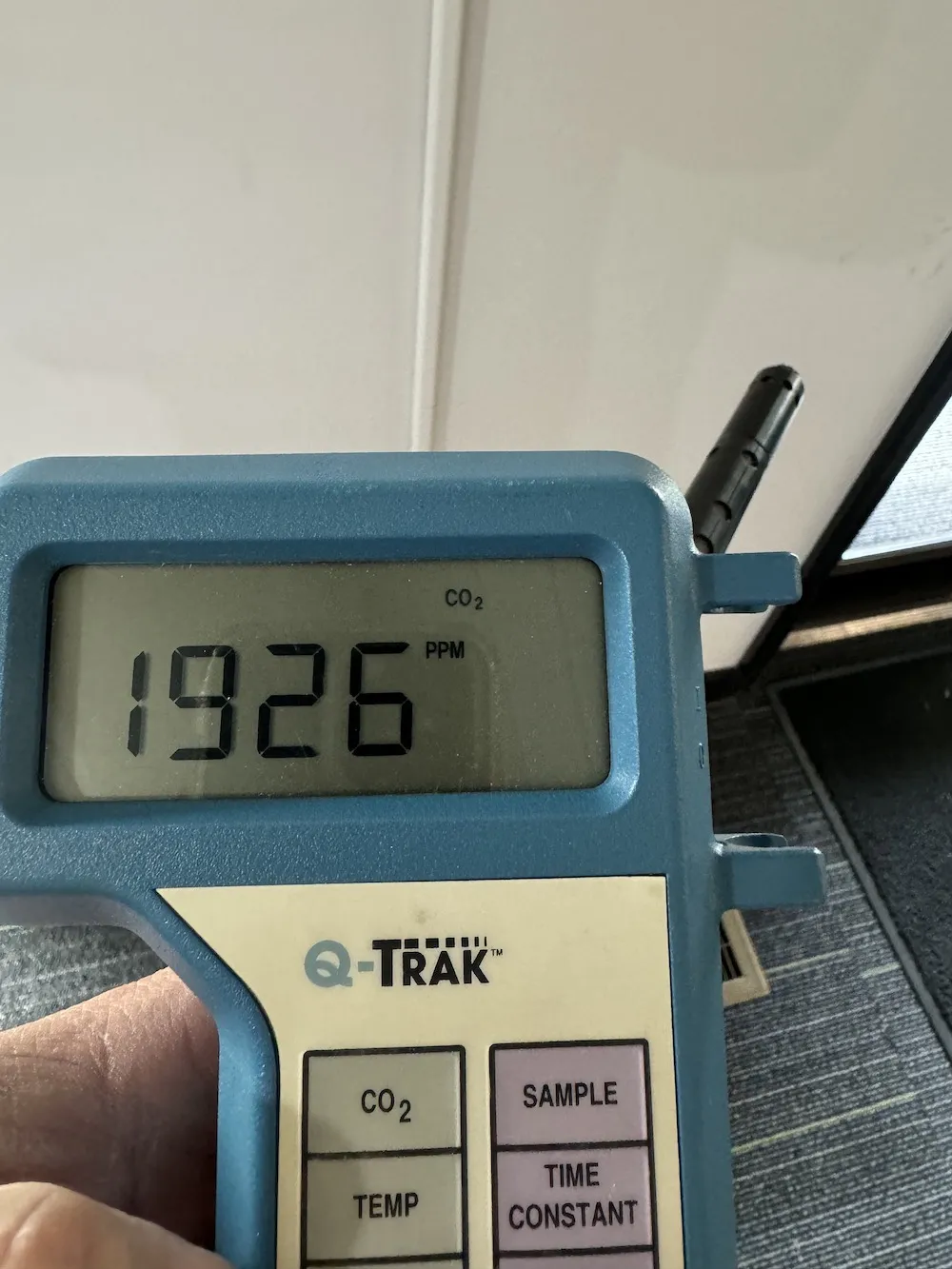
CO2 is the simplest indicator of whether a space has enough fresh air. Outdoor air is about 420 ppm. Comfortable indoor levels stay under 1,000 ppm. Above 1,200-1,500 ppm, people start to report drowsiness, headaches, and concentration issues. Above 2,000 ppm is genuinely problematic. We measure in real-time with a calibrated Q-TRAK meter.
Carbon Monoxide (CO)
Unlike CO2, carbon monoxide is acutely toxic. We measure indoor and combustion-zone CO with calibrated instruments. The presence of any sustained CO above background indicates a combustion-appliance issue that needs immediate attention.
Particulate Matter (PM2.5 / PM10)
Fine particulate is one of the biggest contributors to respiratory irritation. We measure PM2.5 (most damaging to the lungs) and PM10 (general dust load) in real time across the property.
Volatile Organic Compounds (VOCs)
Formaldehyde, benzene, xylene, and dozens of other VOCs off-gas from new furniture, flooring, paint, cleaning products, and cosmetics. We can do real-time total VOC readings or lab-confirmed individual-compound sampling depending on what you need to know.
Humidity & Temperature
Sustained humidity above 60% creates mold-friendly conditions. Below 30% causes respiratory irritation and shrinks wood. We map humidity and temperature throughout the property to find the rooms where conditions are off.
Biological Contaminants
If symptoms or visual evidence suggest a biological source, we can add air sampling for mold spores, dust mite allergens, or other biological particulates.
Real-time measurements vs. lab samples: Field readings give you immediate results — CO2, CO, particulate, humidity, temperature are all reported the same day. Lab-analyzed VOC and biological samples take 2-5 business days for results.
The Report You Get
Every IAQ assessment ends in a written report that includes:
- Real-time readings for every room and zone measured
- Lab-confirmed results for any analytical sampling
- Comparison to EPA, ASHRAE, and OSHA guideline values
- Plain-English interpretation of what readings mean
- Specific recommendations: increase ventilation here, address combustion appliance there, run a dehumidifier in this zone, etc.
What Comes After Testing
Most IAQ fixes are simpler than people expect: better ventilation (an HRV or ERV system), dehumidification in problem zones, source removal of high-VOC materials, or maintenance of combustion appliances. We’ll outline what your specific property needs and point you to the right specialists for any work that’s beyond a homeowner-DIY scope.
Where We Test
Air Test Pros provides indoor air quality testing across our full 13-county service area — Capital Region homeowners, Hudson Valley offices, schools, daycares, multi-family buildings, and any property where someone is asking the question “what’s in our air?”